---
title: "When Execution Gets Cheap, Does Taste Become the Moat?"
description: "For twenty years the mantra was that ideas are worthless and execution is everything. That stops holding when execution is cheap, and taste as curation is not what replaces it."
published: 2026-02-18
tags: ["AI safety startups"]
importance: 5
confidence: "likely"
docStatus: "finished"
cover: "https://jacquesthibodeau.com/content/images/2026/02/taste-moat-header-1.jpg"
coverAlt: "The bell curve meme: “my ideas are precious” at the low end, “execution is all that matters” weeping in the middle, and “great ideas are actually precious” hooded at the high end."
audio: "https://pub-4ee2f71bc29541a7a6e8d9694f0a1b21.r2.dev/69962f8de6be84e878484cc3/audio.mp3"
figures:
- src: "https://jacquesthibodeau.com/content/images/2026/02/HBTZ52qbcAEoi9Z.jpeg"
alt: "A still of Steve Jobs in a 1990s television interview, subtitled “Ultimately, it comes down to taste.”"
width: 2000
height: 1451
viewer: "lightbox"
author: "Jacques Thibodeau"
canonical: "https://jacquesthibodeau.com/when-execution-gets-cheap-does-taste-become-the-moat/"
---
For 20 years, the startup mantra has been: "Ideas are worthless. Execution is everything."
That era is ending.
When AI executes 10x faster and cheaper than a team of engineers, execution stops being the differentiator. The game shifts to taste. Which problems are worth solving. Which solutions are good. What to build before the market tells you. How do your internal systems allow you to accelerate faster than any of the competition.
Scott Stevenson calls this ["High-Frequency Software."](https://x.com/scottastevenson/status/2023773782393909548) When stock trading moved from floor traders shouting in the pit to algorithms executing millions of trades per day, it wasn't the same game. A phase shift occurred. The skills that won in the pit didn't translate.
Software is hitting that same phase shift.
When execution costs approach zero, a few things flip:
**Ideas become precious.** Anyone can build your product in a weekend. Your only moat is knowing what to build and why. Stealth becomes rational again.
**Speed becomes strategy.** AMP, a coding agent company, killed [tab completion](https://ampcode.com/news/tab-tab-dead), their [VS Code extension](https://ampcode.com/podcast/episode-10), [forking](https://ampcode.com/news/stick-a-fork-in-it), and [custom commands](https://ampcode.com/news/slashing-custom-commands) in weeks. Not because they were bad. The field moved. They treat shipping as research. Build, test, learn, kill, repeat.
**Companies become funds.** Instead of one product climbing one gradient, the best companies run portfolios of bets.
But speed without vision accelerates you into a local minimum. You can get early traction, but then customers pull you in ten directions. All your time goes to urgent requests. You never build what actually matters (the non-urgent but highly important square in the Eisenhower matrix).
The trap: most startups solve an immediate need and climb the gradient of customer feedback. As [James Grugett put it](https://x.com/jahooma/status/1974589357010133480): "Most YC startups solve an immediate business need and climb a gradient based on customer feedback. We're not really doing that. Instead, we're building our vision of the future. It's a much worse strategy, most of the time. Occasionally, it really works."
The alternative is harder. Build the acceleration engine, not just the product.
Build the self-evolving codebase, the automated pipelines, the infrastructure that lets you outpace anyone who copies your features. By the time you launch publicly, catching up isn't hard.
One more thing. The technical CEO becomes an unfair advantage in this era.
Not because they code faster than AI. Because a technical polymath sees where the field is going, identifies the capability gaps in models, and makes the right bets about what will stand. The less technical your leadership, the faster wrong bets compound.
The underlying assumptions of how you build a company have changed. The founders who rebuild from first principles will define the next decade.
* * *
## The Taste Debate
> taste is a new core skill
>
> Greg Brockman (@gdb), [February 16, 2026](https://twitter.com/gdb/status/2023481258639286401?ref_src=twsrc%5Etfw)
This idea is resonating beyond startup strategy.
[Paul Graham recently tweeted](https://paulgraham.com/taste.html):
> "In the AI age, taste will become even more important. When anyone can make anything, the big differentiator is what you choose to make."
His [essay on taste](https://paulgraham.com/taste.html), originally published in 2002, argues that great work stems from exacting taste combined with the ability to execute it. That recipe hasn't changed. What's changed is that AI collapsed the execution side of the equation, leaving taste as the exposed variable.
Not everyone agrees. Will Manidis wrote a sharp counterpoint called ["Against Taste"](https://minutes.substack.com/p/against-taste), arguing that elevating taste as humanity's post-AI role is actually a demotion. His point: for most of history, the relationship between capital and creation was patronage, not curation. The patron didn't select from finished works. The patron animated the work before it existed. Reducing humans to discriminators in an AI loop, selecting from menus of machine-generated options, is the opposite of empowerment.
I think both sides are partly right. Taste as passive curation is a dead end. But taste as strategic vision, the ability to see which futures are worth building and commit to them before the evidence is obvious, that's the kind of taste that compounds. It's closer to what Graham originally meant: not the ability to judge, but the ability to see what's good and then make it real.
The founders who will win aren't the ones with the best eye for design or the sharpest product instincts in isolation. They're the ones who can hold a vision of where the world is going, build the systems to get there faster than anyone else, and have the taste to know which bets are worth making before the market catches up.
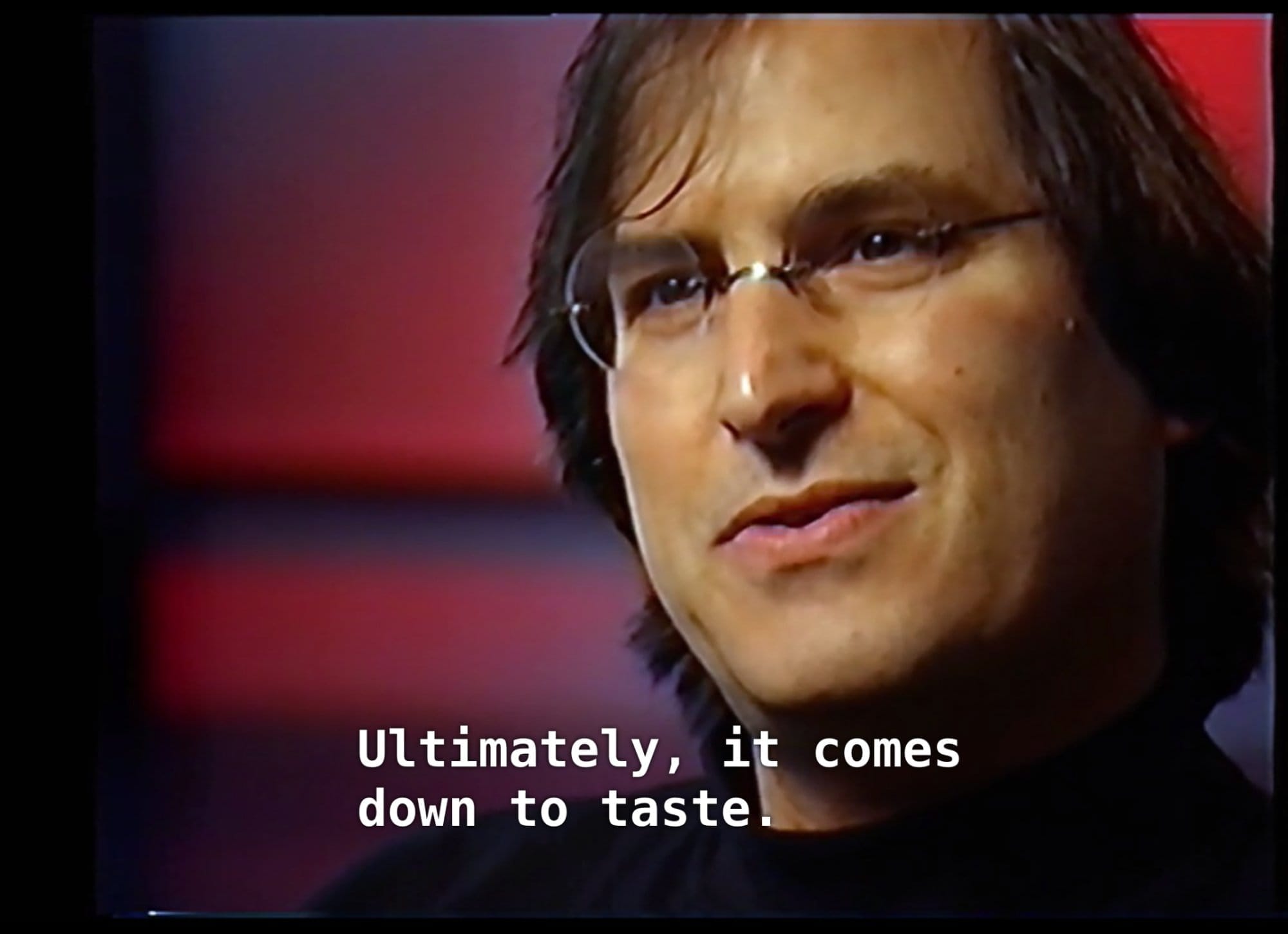
I'll leave you with an [excerpt from Ilya Susketver](https://youtu.be/aR20FWCCjAs?si=jWD3bWscXDSyaT0n&t=5562) on what he considers research taste and how we generate many big ideas. He's been able to see and build the future (e.g. seeing due to his taste and top-down conviction in his ideas:
I think different people do it differently. One thing that guides me personally is an aesthetic of how AI should be, by thinking about how people are, but thinking correctly...
The top-down belief is the thing that sustains you when the experiments contradict you. Because if you trust the data all the time, well sometimes you can be doing the correct thing but there’s a bug. But you don’t know that there is a bug. How can you tell that there is a bug? How do you know if you should keep debugging or you conclude it’s the wrong direction? It’s the top-down. You can say things have to be this way. Something like this has to work, therefore we’ve got to keep going.
* * *
In a future post, I'll cover a list of moats that enable businesses to survive in the age of AI. If you'd like to get notified when it's out, you can subscribe to the blog.
## Sources
Every external link in this piece that has a captured card, with what that page said
when it was captured. The quoted lines below are not the author of this piece writing:
they are the linked page describing itself, recorded by `bun run link-cards` on the date
given, and kept so that a reader still has them if the original moves or goes away.
- **Tab, Tab, Dead** — Amp, ampcode.com, 2026-01-15
Captured 2026-08-28.
> We
- **Episode 10** — ampcode.com
Captured 2026-08-28.
> Quinn and Thorsten announce that the Amp editor extension will soon self-destruct. The time of the sidebar is over.
- **Stick a Fork in It, It** — Amp, ampcode.com, 2026-01-13
Captured 2026-08-28.
> We
- **Slashing Custom Commands** — Amp, ampcode.com, 2026-01-29
Captured 2026-08-28.
> Custom commands are gone. Use skills instead.
- **James Grugett** — @jahooma, x.com, 2025-10-04
Captured 2026-08-28.
> Most YC startups solve an immediate business need and climb a gradient based on customer feedback. We're not really doing that. Instead, we're building our vision of the future. It's a much worse strategy -- most of the time. Occasionally, it really works.
- **Greg Brockman** — @gdb, x.com, 2026-02-16
Captured 2026-08-28.
> taste is a new core skill
- **Taste for Makers** — paulgraham.com
Captured 2026-08-28.
- **Against Taste** — Will Manidis, minutes.substack.com
Captured 2026-08-28.
> Taste arrived quietly, somewhere over the last few months.
- **Ilya Sutskever – We're moving from the age of scaling to the age of research** — Dwarkesh Patel, youtube.com
Captured 2026-08-28.
- **Ilya Sutskever – We're moving from the age of scaling to the age of research** — Dwarkesh Patel, youtube.com
Captured 2026-08-28.